
Hydraulic Oil Filter Construction
Most hydraulic filters are cylindrical devices with openings for fluid input and output in opposite sides of the filter. Fluid is typically directed through channels in the filter housing and passed through the filter media. The media then collects the contaminants and the cleaned fluid passes through a central channel between the filter media, making its way to the output. The contaminants remain stuck within the filter media; when the filter is full to capacity, a switch often triggers an LED or other visual indicator to announce that the filter needs to be changed. A cutaway view of a typical hydraulic filter is shown below; in this case, the filter's clogged status is indicated by the position of a simple piston.

cylinder
The cylinder is the main body of the filter, which is generally composed of three parts: the outer box, the inner box and the end cover.
1. Outer box: used to store various filter materials and accessories. The inner walls are connected with threads to ensure tightness. There are several small round holes on the inner wall, and the filter element or filter piece is installed inside. The outer box and the end cover are bolted together to form an integral structure.
2. The inner box is connected with the end cover with screws to ensure the tightness and tightness of the structure.
3. The end cover is the protective cover of the filter, which is used to protect the filter from damage and play a sealing role.
4. The filter element is the main part of the filter, it is the main part of the filter medium, by a special fiber woven, it can filter impurities, protect the element is not damaged, but also has a certain strength and durability. Filter element commonly used materials are: PP, PVC, PE, PA, etc.
5. Bearing: Ensure lubrication and sealing between filter and bearing.
Types
Hydraulic filters are often classified by where they are designed to be placed in a hydraulic system. The table below describes common filter types.
| Filter Type | Description | Application | Image |
| In-line | Placed directly on the fluid line; may be suction side (before the pump) or pressure side (after the pump but before valves and cylinders); inlet, outlet, and media are aligned. | Pressure side – high pressure fluid
Suction side – lower pressure | 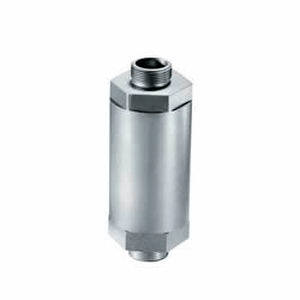 |
| Off-line | Consists of a separate pump and filter linked directly to the reservoir; often used to supplement main system filters. | Systems without continuous flow; systems where return flow volume is too great; lower pressure fluid. | 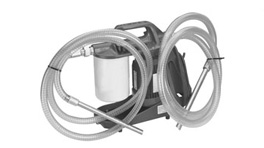 |
| Tank | May be positioned on or within the fluid reservoir; may have an accessible head on the tank exterior for easy access and media replacement. | Low pressure systems; machine tools, forest harvestry equipment, and casting machines. | 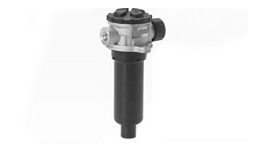 |
| Spin-on | Consists of an in-line head screwed onto a threaded canister; easy to install and economical.. | Systems without flow surges; low pressure systems. | 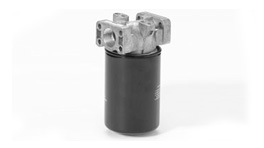 |
| Return line | Filter is placed directly on return line; can also be spin-on, in-line, or tank-mounted. | Systems where pumps need the most protection; economic; casting machines, drilling rigs. | 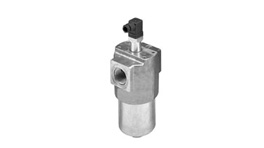 |
| Duplex | Actually a valve/filter assembly permitting flow to two separate filters in order to maintain flow during filter maintenance | Continuous flow systems; critical hydraulic systems | 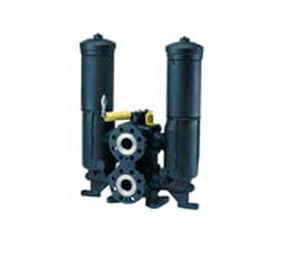 |
Product Form Factor
Hydraulic filter products come in a variety of form factors. Most buyers installing a filter for the first time will select a complete filter, including the filter housing as well as the filter element. Those looking to replace a worn-out or expired filter element may purchase the filter media/cartridge separately without also having to replace the housing. Additionally, buyers may also select a housing — a simple enclosure that directs fluid through the filter media — if need be.
Standards
Hydraulic filters may be manufactured, tested, or used based on various standards. Common filter standards include:
- ISO 16889 -- Hydraulic fluid power — Filters — Multi-pass method for evaluating filtration performance of a filter element
- ISO 2941 -- Hydraulic fluid filters - Filter elements - Verification of collapse/burst pressure rating.
performance
GreenFilter - Filters product series (pdf)
Filter bag
The filter bag is a continuous filter medium woven by metal wire. When there are impurities, it should be cleaned in time to avoid blocking the filter hole without cleaning for a long time. The filter bag forms a layer of microporous film on the surface of the filter medium, which increases the contact area between the liquid and the filter medium, improves the efficiency and flow of the fluid resistance, and increases the cleaning times of the oil. Filter bag is a variety of different structural forms, single layer, double layer, three layer and multi-layer, in addition to the use of different, but also according to its shape, aperture size and number. Improper selection of filter bag will affect the working performance and even damage the components. In the installation process, ensure that the filter bag is flat, placed perpendicular to the ground and tightened with bolts.
The quality of hydraulic oil filter is the guarantee of safe operation of hydraulic system. When the quality of hydraulic oil is not good or pollutants into the hydraulic oil will cause the deterioration of system performance and component damage. In order to ensure the reliability of the hydraulic system operation, improve the efficiency, must be installed in front of each component into the hydraulic oil one or several different structure types, aperture size and number of appropriate filter bags to filter the impurities in the oil, water and mechanical impurities.